The Words in Parentheses: A Practical Decoder for Indian Menu Labels
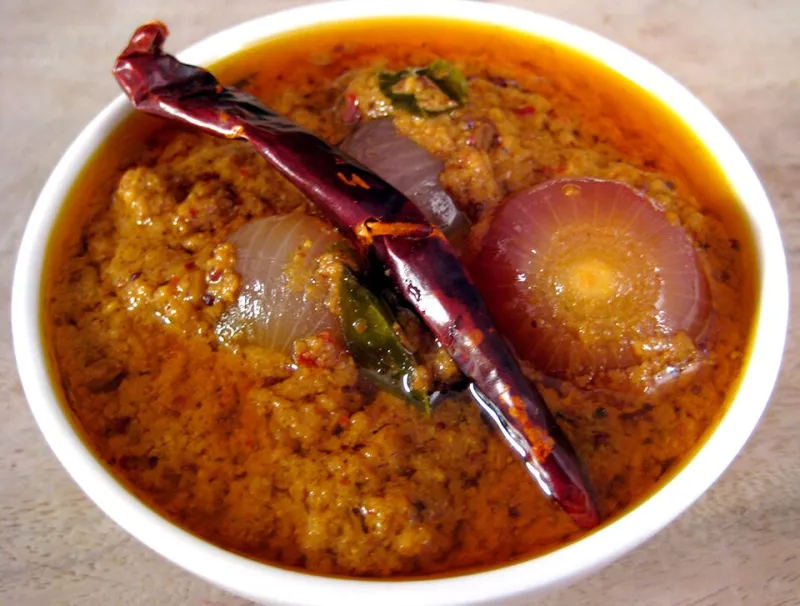
Photo: Chongkian, CC BY-SA 4.0, via Wikimedia Commons
At a lot of Indian restaurants in the US, the menu does its most useful talking in parentheses. The main line might say “Chicken Curry,” but the small note after it says “Andhra,” “Chettinad,” “Malabar,” or “homestyle.” That is not marketing filler. It is the kitchen telling you which direction the dish is about to go: how hot, how sour, how rich, how dry, and what kind of texture to expect with your rice or bread.
Think of the parentheses as a compact regional guide. They will not tell you everything, and they are not always used with perfect consistency. But they are a much better ordering tool than the mild-medium-hot scale, which flattens a lot of useful detail into a single vague promise.
Start With the Parenthetical, Not the Protein
Most menus lead with the protein because that is what sells: chicken, lamb, paneer, shrimp. The parenthetical is where the kitchen explains how it plans to cook it. “Chicken” is an ingredient. “Chettinad chicken” is a spice strategy. “Malabar shrimp” is a coastal direction. “Homestyle dal” is a texture and comfort cue.
So before you pick a dish, scan the labels. If your table has one person who wants gentle food and another who wants a real chili kick, the parentheses let you build a meal instead of gambling on it.
Homestyle: The Comfort Signal
“Homestyle” is less a region than a promise of restraint. It usually means the kitchen is aiming for the kind of everyday cooking you might find in a home kitchen rather than the richer, heavier style often built for restaurant menus. That often translates to a simpler tadka, a lighter gravy, more vegetable-forward dishes, and a balance of salt, sour, and heat rather than a wallop of cream.
It does not automatically mean mild. In some homes, “homestyle” means a fierce green chili chutney on the side. But it generally signals a softer texture and a less showy plate. If you are ordering for a mixed table, homestyle dishes are good anchors: dal, seasonal vegetables, simple chicken preparations, and rice-friendly curries.
Ask your server what “homestyle” means at that particular restaurant. Some kitchens use it for family recipes. Others use it to distinguish a lighter preparation from a creamier restaurant version. Both are useful, but they are not the same thing.
Andhra: Heat With a Point of View
Andhra cooking, from the Telugu-speaking regions of southern India, is often the label US menus use when they want to say “this one is serious about chili.” That is fair, but it is only part of the story. Andhra food is not just hot. It is hot with acid, curry leaves, garlic, and a savory depth that keeps the heat from tasting flat.
Look for words like gongura, avakaya, pulusu, or “Andhra-style” next to chicken, fish, or vegetable dishes. You may get tamarind sourness, dried red chilies, and a gravy that wants rice. The heat can build. If you are heat-curious but not heat-committed, order one Andhra dish for the table and pair it with a cooling raita, plain rice, or a mild dal.
And do not assume “Andhra” is a dare. It is a regional signal. Treat it as a clue that the kitchen is leaning into chili, sourness, and a bold finish rather than cream and sweetness.
Chettinad: Pepper, Roasted Spice, and Layers
Chettinad is a region in Tamil Nadu with a distinctive spice tradition, and the label usually means the kitchen is working with black pepper, fennel, star anise, cinnamon, coconut, and roasted spices. The heat is often drier and more aromatic than the chili-forward punch of an Andhra dish. You feel the pepper and the spice blend before the burn.
On US menus, “Chettinad” often shows up with chicken or lamb, sometimes in a thick, dark masala. It is a good choice for someone who wants complexity more than sheer heat. The dish should smell toasted and layered, not just spicy. If you are ordering bread, parotta or naan works, but rice is just as useful for catching the masala.
Malabar: Coconut, Curry Leaves, and the Coast
Malabar refers to the southwestern coast of India, and the label usually points toward coconut, curry leaves, tamarind, and seafood. It often signals a richer, more aromatic gravy with gentler heat than Andhra or Chettinad. Coconut milk may show up. Fish and shrimp are common. The acidity might come from tamarind or lime rather than tomato.
This is a useful label for a table that wants flavor without a chili contest. It is also a good reminder that “Indian food” is not one heat level. A Malabar-style fish curry can be deeply savory and fragrant while still being friendly to a cautious eater.
Punjabi: Butter, Wheat, and Generosity
“Punjabi” on a US menu usually signals the northern restaurant toolkit: tomato-onion gravies, cream, ghee, tandoor breads, and a generous hand with richness. It does not necessarily mean mild, but it often means heavier and more rounded than the southern coastal labels. Think butter chicken, dal makhani, saag, and breads that arrive hot and blistered.
If your table is ordering several dishes, one Punjabi-style dish can act as the rich anchor. Just balance it with something lighter, something sour, or something vegetable-forward. Otherwise the whole meal can lean creamy.
Other Parentheses Worth Knowing
You will also see labels like Hyderabadi, Goan, Kolhapuri, Kashmiri, Bengali, and Udupi. Hyderabadi often suggests dum cooking, fried onions, saffron, and chili. Goan can mean vinegar, coconut, and seafood. Kolhapuri is usually a heat warning. Kashmiri is often aromatic and less chili-driven than people expect. Bengali points toward mustard oil, panch phoron, fish, and subtle sweetness. Udupi signals vegetarian cooking with coconut, curry leaves, and a lighter hand.
None of these are absolute. Menus adapt. Kitchens interpret. But the words are still useful because they give you a direction of travel.
How to Order a Table That Matches
Pick one dish for heat, one for cooling, one for sourness, and one for richness. Use the parentheses to decide which is which. If you order an Andhra chicken and a Chettinad lamb, add a mild dal, raita, or vegetable dish so the table has somewhere to retreat. If you order a Malabar fish curry and a Punjabi dal, you have richness and coast in the same meal.
And if the parentheses are still unclear, ask. “Is the Chettinad pepper-forward or chili-forward?” is a better question than “Is it spicy?” The answer will tell you more about what is actually coming to the table.
The parentheses are not fine print. They are the menu’s best attempt to help you order well. Read them, ask about them, and use them to build a meal that fits the people at your table.